
Federal Pacific & Zinsco Electrical Panels In Greenville
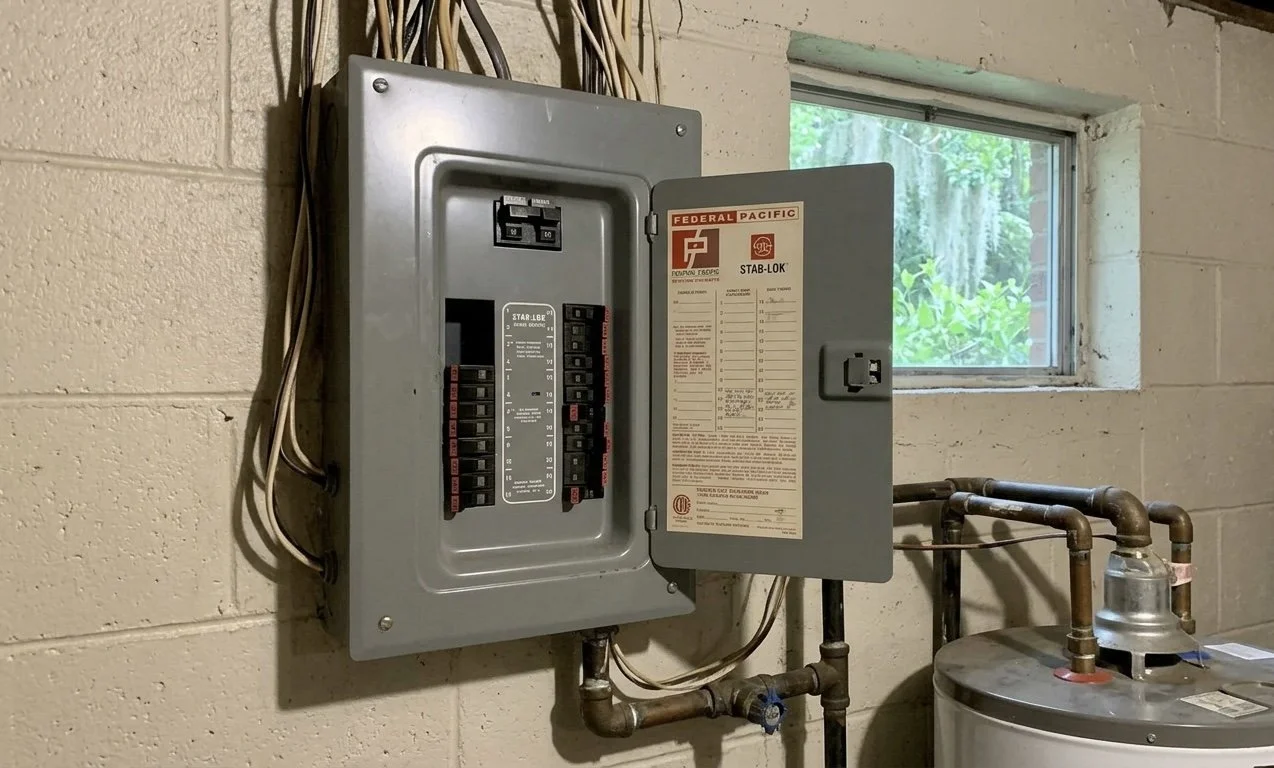
If you own an older home in Greenville or anywhere in the Upstate South Carolina region, there is a strong chance your home was built or equipped with a Federal Pacific or Zinsco electrical panel. These panels were installed in millions of homes throughout the United States during the 1950s, 1960s, 1970s, and into the 1980s, and many are still in service today, decades after they should have been replaced.
An electrical panel is the single most essential component of your home's electrical system. It receives power from the utility grid and divides it into separate circuits that distribute electricity throughout your property. It protects your home from overloads and keeps your lights on safely. It is no exaggeration to say that your electrical panel is the heart of everything electrical in your home. But what happens when that panel was installed 40 or even 50 years ago and was never designed to last this long?
Two names come up regularly during electrical inspections of older homes in Greenville: Federal Pacific and Zinsco. Many homeowners in the area have no idea that these panels pose a serious risk to their property and to the people living in it. Others are aware of the concerns but choose to ignore them, reasoning that if the panel is still working, there is no reason to replace it. That logic sounds reasonable on the surface, but it does not hold up when you look at what the research actually says about these panels.
This article was written specifically for homeowners and business owners in Greenville, Spartanburg, and the entire Upstate South Carolina region. Our goal is to give you factual, straightforward information about Federal Pacific and Zinsco electrical panels so you can make an informed decision about your home's electrical safety. Inside this guide, you will find everything you need to know: what these panels are, how to spot one in your home, what the research says about their safety record, why replacement is the only real solution, and exactly what steps to take if your home has one of these panels installed.
Even if your home does not have one of these panels, this is valuable information to know. A neighbor, a family member, or a property you are considering purchasing could have one. The more homeowners in Greenville understand this issue, the safer our community becomes.
Why This Topic Relevant to Greenville Homeowners
Federal Pacific and Zinsco electrical panels are more common in Greenville County than most people realize. These panels were heavily used during a period of rapid residential construction across the United States, and Greenville County was no exception.
A Greenville County housing analysis reveals that the county's population grew from 168,152 residents in 1950 to 240,774 residents by 1970. That population boom came with a massive wave of residential construction. More than 71,000 housing units were built during the 1950s, 1960s, and 1970s as Greenville County expanded faster than much of the rest of the country. Federal Pacific and Zinsco panels were among the most commonly used panels by builders during exactly that period.
Neighborhoods throughout Greenville, Simpsonville, Mauldin, Greer, Taylors, Easley, and surrounding communities that were developed during those decades are highly likely to have homes that still carry the original electrical panel from when they were constructed. In some cases, these panels have been running continuously for 50 or 60 years without ever being inspected or replaced.
This is not purely a residential concern either. Older commercial buildings in Greenville County face the same issue. Business owners operating out of structures built before 1990 should take this topic just as seriously as any homeowner.
Home inspectors in the Greenville area regularly flag Federal Pacific and Zinsco panels during real estate transactions. It has become a well-known issue that comes up frequently in home sales throughout the Upstate. If you purchased a home in this area that was built before 1990 and have never had the electrical panel inspected or replaced, there is a realistic possibility that you are living with one of these panels right now.
What Are Federal Pacific and Zinsco Electrical Panels?
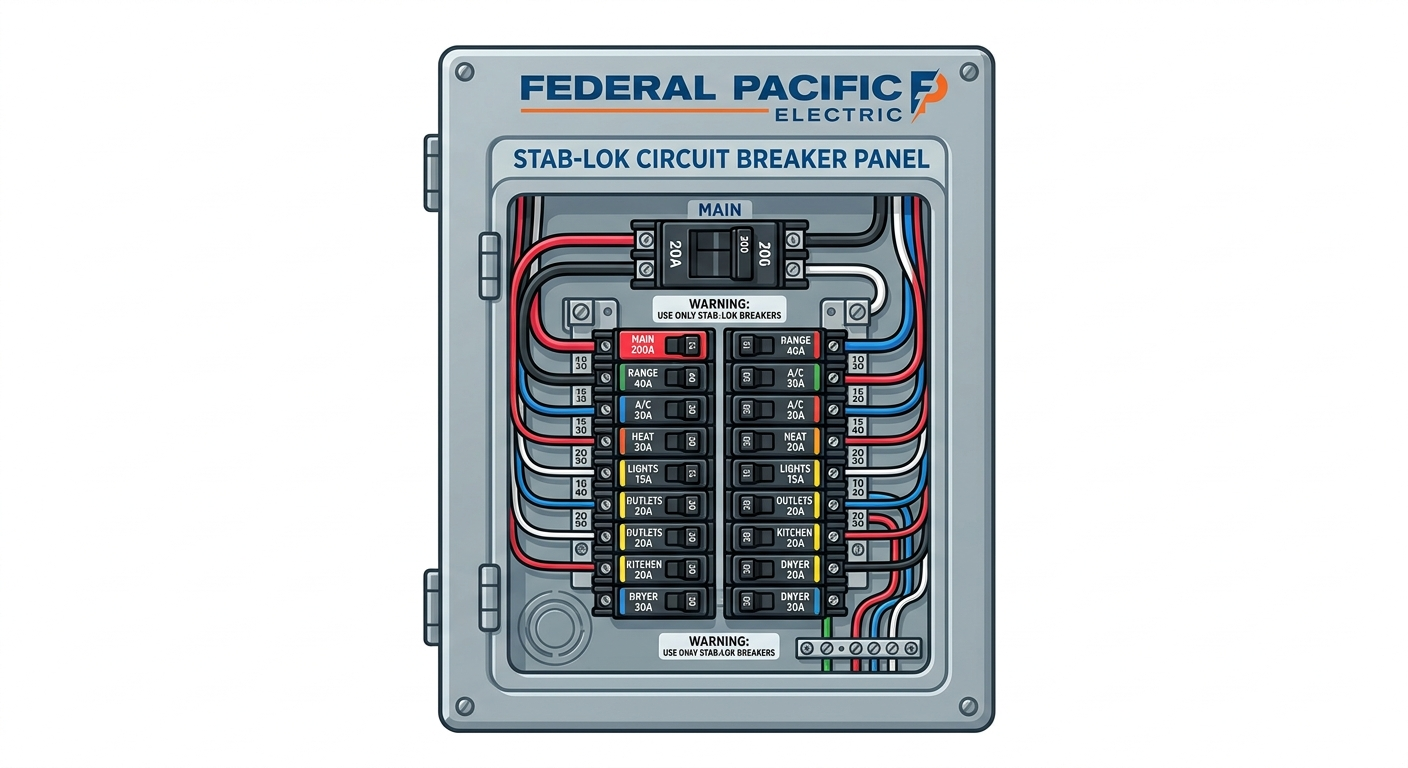
Federal Pacific Electrical Panels
Federal Pacific electrical panels, commonly referred to as FPE panels or Stab-Lok panels, were manufactured and heavily marketed by the Federal Pacific Electric Company from the 1950s through the 1980s. During that thirty-year period, these panels were installed in an enormous number of residential and commercial properties throughout the United States and Canada, including the new construction homes being built across Upstate South Carolina at that time.
These panels were sold under the Stab-Lok name, a reference to the design of the circuit breakers used inside the panel. In theory, these breakers were supposed to function exactly like any other circuit breaker: trip and cut power when a circuit becomes overloaded or a fault occurs in the electrical system, preventing overheating and fire. The problem is that independent studies, investigations, and years of field research found that these breakers frequently failed to do exactly that.
What the Research Found
The U.S. Consumer Product Safety Commission launched a formal investigation into Federal Pacific Stab-Lok panels. CPSC-hired electrical experts tested Stab-Lok breakers pulled from homes built between 1960 and 1985. The results showed that 51 percent of the tested breakers failed to trip under overload conditions. The investigation was ultimately halted due to budget constraints, but the findings did not disappear.
Independent forensic electrical engineer Dr. Jesse Aronstein published research titled "Hazardous FPE Circuit Breakers and Panels: Information for Homeowners, Inspectors, and Electricians," which confirmed the same 51 percent failure rate found by the CPSC. Broader testing conducted by the CPSC alongside at least four independent companies from 1979 to 1983 found failure-to-trip rates ranging from 14 to 74 percent, with critical safety failures reaching as high as 80 percent in some tests.
Aronstein's continued independent testing confirmed that the same failure rates found in the early 1980s were still present in panels being pulled from homes many years later. The problem was not isolated to one production run or one era. It was consistent across the board.
What many homeowners do not know is that replacement breakers were eventually brought to market, specifically the UBI breakers sold by Connecticut Electric and marketed as a safer alternative to the original FPE breakers. Aronstein's research found that these replacement breakers actually carried a higher failure rate than the originals, failing at a rate of 71 percent on double-pole breakers. That finding is critical because it tells you the problem is not just a manufacturing defect that can be corrected with new parts. The Stab-Lok design itself is fundamentally flawed, and no amount of rebranding or replacement breakers can fix that.
Aronstein co-authored a peer-reviewed paper published in IEEE Transactions on Industry Applications in January/February 2012, alongside co-author Richard Lowry. That paper estimated approximately 2,800 residential fires per year are associated with defective FPE Stab-Lok breakers, resulting in an estimated 116 injuries, 13 deaths, and $40 million in property damage annually.
The testing covered more than 3,000 breakers pulled from real homes, tested across multiple brands, multiple years, and multiple locations. The failure rates were consistent across every sample. This was not a small or isolated study. It is a body of research that directly and factually establishes the danger of these panels.
The Legal and Corporate History
In 2002, a class action lawsuit in New Jersey resulted in a court ruling that Federal Pacific had violated the New Jersey Consumer Fraud Act over many years. The court specifically found that Federal Pacific knowingly and purposefully distributed circuit breakers that had not been tested to meet UL standards, despite labeling that indicated otherwise.
Federal Pacific Electric stopped manufacturing residential circuit breakers and panels in the mid-1980s. The company did not shut down because of a government recall or a voluntary safety decision. It collapsed under the weight of its own fraud. Underwriters Laboratories pulled its certification, the CPSC investigated it, the company's parent organization sued it, and a major corporate buyer found the liability so significant it attempted to reverse a billion-dollar acquisition because of it. The brand passed through a chain of corporate owners until it effectively dissolved.
Because there was never an official recall, millions of Federal Pacific panels were simply left in place. Many are still running in homes across the country today, including right here in Greenville County.
We share all of this so you understand why licensed electricians, home inspectors, and insurance companies treat these panels as a serious safety concern. A recommendation to replace your Federal Pacific panel is not an upsell or a precaution taken out of habit. It is grounded in decades of research, legal history, and documented real-world consequences.
Zinsco Electrical Panels
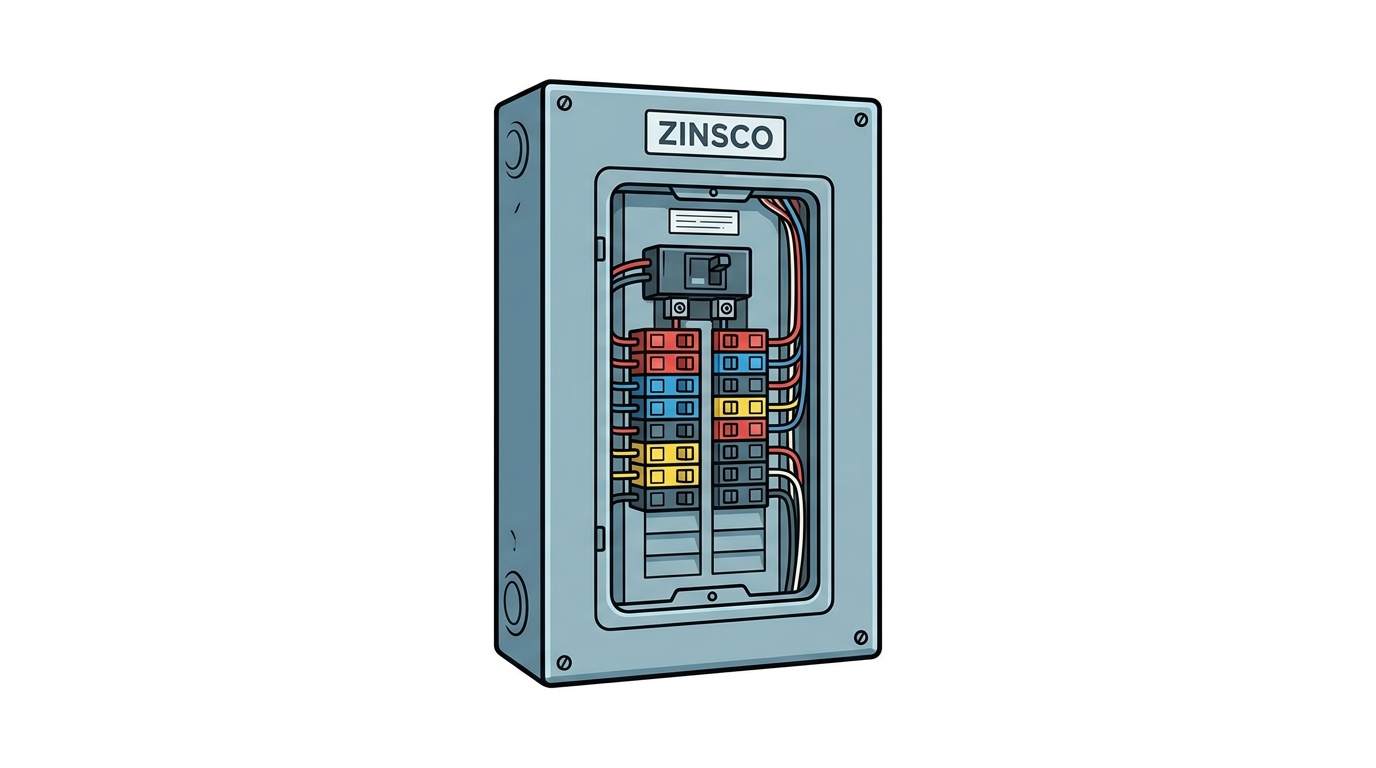
Zinsco electrical panels, also sold under the name GTE-Sylvania, were manufactured and installed during a very similar time period to Federal Pacific panels, from the 1950s through the 1980s. Hundreds of thousands of these panels were installed in homes throughout the United States, and a significant number of them remain in place in older homes and buildings across Upstate South Carolina.
The core failure of Zinsco panels mirrors that of Federal Pacific: the breakers fail to trip during overloads and short circuits. Over time, Zinsco breakers are known to melt and, in some cases, fuse directly to the bus bar inside the panel. Once this happens, the breaker cannot switch off at all, not even manually. The result is a circuit that has no protection whatsoever, and electrical current can continue flowing through wiring that cannot safely carry it, creating a serious overheating risk inside the walls of the home.
Zinsco panels also used aluminum bus bars rather than copper. Aluminum is more prone to corrosion and heat damage than copper, and in aging panels this becomes an additional point of failure.
What the Research Found
Dr. Jesse Aronstein, the same forensic electrical engineer whose work established the dangers of Federal Pacific panels, conducted independent testing on Zinsco circuit breakers. His findings showed that approximately 29 percent of Zinsco breakers failed to trip under standard overload conditions. A separate investigation by electrical expert J.P. Simmons produced a similar result, finding that nearly 32 percent of tested Zinsco breakers failed to trip as required. To put that number in context, that failure rate is roughly 300 times higher than what you would expect from a modern circuit breaker.
Field reports collected from licensed electricians and home inspectors across the country, documented by InspectAPedia and shared with the U.S. Consumer Product Safety Commission, found that approximately 25 percent of Zinsco and Sylvania panels inspected showed physical damage. In some cases, the damage was so severe that breakers had permanently welded themselves to the bus bar and broke apart upon removal.
No Recall, But a Clear Record
Unlike Federal Pacific, Zinsco panels never faced a formal government recall, a court ruling, or a revocation of their UL listing. The panels simply went out of production in the early 1980s and the issue was never officially addressed by regulators. What exists in place of a formal verdict is something equally compelling: decades of consistent, independent findings from electricians, forensic engineers, home inspectors, and researchers across the country, all documenting the same failures. Breakers that do not trip, bus bars that overheat, and connections that weld permanently shut.
The absence of a legal verdict does not make these panels safe. The evidence from the field is clear enough on its own.
Both panels were popular during the same era of residential construction, and both present the same category of danger: a circuit protection system that cannot be relied upon to protect your home.
Why Federal Pacific and Zinsco Electrical Panels Need to Be Replaced
Understanding the history of these panels is important, but the more practical question is: what does all of this mean for your home right now? Here is why replacement is not optional.
The Fire Risk Is Real and Documented
The most serious concern is fire. When a circuit breaker fails to trip during an overload or short circuit, dangerous amounts of electrical current continue flowing through wiring that cannot safely carry it. That wiring overheats inside the walls of your home. Overheated wiring inside walls is one of the leading causes of house fires, and electrical fires that start inside walls can spread significantly before anyone notices them.
The research is not theoretical. As noted above, peer-reviewed findings estimated approximately 2,800 residential fires per year are linked to defective Federal Pacific Stab-Lok breakers alone. Zinsco panels carry a comparable documented failure rate. These are not rare or unlikely outcomes. They are consistent findings that have held up across decades of independent investigation.
Insurance Complications
Insurance companies in South Carolina are well aware of Federal Pacific and Zinsco electrical panels, and many of them have taken a firm position on coverage. Some insurers will refuse to issue or renew a homeowner's policy on a property that has one of these panels. Others will insure the property but at a significantly higher premium that reflects the elevated risk. If you have noticed that your homeowner's insurance is unusually expensive or has recently been denied or non-renewed, the electrical panel may be the reason.
Real Estate and Home Sale Issues
During real estate transactions in South Carolina, Federal Pacific and Zinsco panels are a common reason for failed home inspections. Home inspectors are trained to identify these panels, and when they do, it typically creates a requirement for resolution before the sale can close. Sellers who discover this issue during a transaction may be required to replace the panel as a condition of sale, often under time pressure and without the opportunity to plan ahead. Addressing the panel before listing avoids that situation entirely. Buyers who discover one of these panels during inspection should request a full replacement or a credit toward replacement as part of the negotiation, not a reduction in price that leaves the problem for them to deal with later.
Code Compliance
Electrical codes have evolved considerably since these panels were manufactured. Modern electrical safety standards in South Carolina require panels that meet current requirements, and Federal Pacific and Zinsco panels do not. This matters not only during real estate transactions but also when homeowners plan renovations, additions, or upgrades that require an electrical permit. An outdated panel can hold up or complicate that process significantly.
Age and Component Degradation
Even setting aside the documented design flaws, these panels are old. Electrical components degrade over time, and panels that are 40, 50, or 60 years old were never designed to operate for this long. Internal components have deteriorated, connections have loosened, and the risk of failure increases with every additional year the panel remains in service. Age alone would be a valid reason to consider replacing an electrical panel of this vintage, and when you add the documented failure rates on top of that, the case for replacement becomes very straightforward.
How to Tell If Your Home Has a Federal Pacific or Zinsco Electrical Panel
The good news is that you do not need to be a licensed electrician to do a basic check on your electrical panel. Here is a simple step-by-step process you can follow on your own.
Step 1: Locate Your Electrical Panel Your electrical panel is a metal box mounted on the wall, typically found in a utility room, garage, basement, hallway, or dedicated closet. It is usually labeled as a circuit breaker box or breaker panel. If you are unsure where yours is, start by looking near your laundry room, in the garage, or in a mechanical area of the home.
Step 2: Look for the Brand Name Open the panel door and look for a name printed on the inside of the door, on the panel itself, or directly on the individual breakers. Look for any of the following: Federal Pacific, Stab-Lok, Zinsco, or GTE-Sylvania. The presence of any one of these names is a clear indicator that you have one of these panels.
Step 3: Look at the Breakers Federal Pacific Stab-Lok breakers are often identifiable by a distinctive red stripe or red markings on the breakers themselves. Zinsco breakers tend to be colorful and may appear in blue, green, or yellow. These colors stand out compared to the standard black or gray breakers found in most modern panels.
Step 4: Consider the Age of Your Home If your home was built between 1950 and 1985 and the electrical panel has never been replaced, you have a meaningful reason to investigate further. This is especially relevant for homes in Greenville-area neighborhoods that were developed during those decades.
Step 5: Check the Condition of the Panel Regardless of brand, any panel that shows signs of scorching, melting, rust, or a burning smell near the box should be treated as an immediate concern and inspected by a licensed electrician right away.
Step 6: Schedule a Professional Electrical Inspection If you are uncertain about any of the above, the most reliable step is to schedule an electrical panel inspection in Greenville with a licensed electrician. A licensed professional can confirm the brand, assess the current condition of the panel and the surrounding wiring, and give you clear guidance on what your next steps should be. A thorough electrical inspection is recommended every three to five years for any home, and if you have never had one done, now is a good time to start.
What to Do If Your Home Has a Federal Pacific or Zinsco Panel
If you have confirmed or suspect that your home or business has a Federal Pacific or Zinsco electrical panel, here is a clear, practical course of action based on our experience as a licensed electrical contractor in Greenville.
Do Not Ignore the Problem
This is not a situation where waiting to see if something happens is a reasonable approach. The risks behind these panels are real, documented, and supported by decades of independent research. The longer these panels remain in service, the higher the probability of a serious incident. Treat this as a priority.
Schedule a Professional Electrical Inspection Right Away
The first step is to have a licensed electrician perform a thorough electrical inspection of your panel and your home's overall electrical system. A professional inspection will confirm the brand and model of the panel, assess its current physical condition, evaluate your home's overall electrical load, and help determine what size and type of replacement panel your home requires. Do not delay this step, and do not attempt to assess the panel yourself beyond the basic visual checks described above.
Plan for a Full Panel Replacement
Once an inspection confirms you have a Federal Pacific or Zinsco panel, a full replacement is the appropriate course of action. Individual breaker swaps are not a solution. As the research clearly shows, replacement breakers for these panels carry the same fundamental design flaws and cannot be relied upon as a long-term fix. A full panel replacement is the only approach that actually eliminates the risk.
Electrical panel replacement in Greenville is a standard service performed by licensed electrical contractors. The process involves safely removing the old panel, installing a new modern panel, transferring all circuits to the new panel, and ensuring everything is properly grounded and up to current code. A permit is required for this work, and the completed installation must be inspected by your local authority having jurisdiction.
Hire a Licensed and Insured Electrical Contractor
Panel replacement is not a project for a general handyman or an unlicensed contractor. It involves direct work with your home's main electrical service, which carries serious risk if handled improperly by someone without the proper training, licensing, and insurance. A licensed electrical contractor near you will pull the required permits, perform the work to code, coordinate the inspection, and stand behind the quality of the installation. When searching for a licensed electrician near you or an electrical contractor near you for this type of work, verify their license status and ask about their experience specifically with panel replacements.
Notify Your Insurance Company After Replacement
Once your panel has been replaced, contact your homeowner's insurance provider to notify them of the upgrade. In many cases, replacing a Federal Pacific or Zinsco panel can change your coverage eligibility and may reduce your premium. This is a conversation worth having as soon as the work is complete.
Address the Panel During Real Estate Transactions
If a home inspection during a purchase or sale reveals a Federal Pacific or Zinsco panel, both parties benefit from resolving it quickly. Sellers who address the panel before listing avoid the complication of it becoming a negotiating point or a condition of closing. Buyers who discover one during inspection should make full replacement, not a price reduction, a priority in their negotiations.
If you're considering a new electrical panel installation, our article "Installing Electrical Panel in Greenville: Complete Guide" covers everything you need to know, from understanding what an electrical panel is and its key components, to local legal requirements, the installation process itself, and the differences between residential and commercial installs. Check it out to get fully informed and prepared before any work begins on your property.
Frequently Asked Questions (FAQs)
-
Not necessarily, but it is a serious safety concern that should not be left unaddressed. If you notice signs of scorching, a burning smell near the panel, flickering lights, or breakers that will not reset, call an electrician right away. If the panel appears to be in stable condition on the outside, you should still have it inspected and plan for replacement as soon as reasonably possible. Stable-looking does not mean safe.
-
Electrical panel replacement in Greenville typically ranges from $1,500 to $4,500 for most residential properties, depending on the size of the panel, the condition of the existing wiring, and whether a service upgrade is needed alongside the replacement. Every home is different, and the most accurate way to get a number is to have a licensed electrician perform an on-site evaluation before any work begins.
-
Most residential panel replacements are completed in a single day. Your power will need to be off for part of the day during the work, but the majority of homeowners are fully back up and running by the end of the job.
-
Replacement breakers for Federal Pacific Stab-Lok panels are still available on the market, but most licensed electricians will not recommend them as a real solution. As the research shows, the replacement breakers marketed for these panels have been found to carry the same fundamental design flaws as the originals, with some failing at an even higher rate. The panel itself has structural problems that go beyond any individual breaker, and individual replacements do not eliminate the underlying risk. A full panel replacement is the only proper solution.
-
Yes. Electrical panel replacement in Greenville requires a permit, and the completed work must pass an inspection by a licensed electrical inspector. Any reputable electrical contractor will handle the permit process as part of the project.
-
Yes, you should have it inspected. A home built during that period that has never had the panel replaced has a meaningful chance of still carrying the original Federal Pacific or Zinsco panel. Even if it turns out to be a different brand, a panel of that age should still be evaluated by a licensed electrician to assess its current condition and capacity.
-
Look for a licensed and insured electrical contractor in Greenville with documented experience in electrical panel replacements and upgrades. Confirm that they will pull the required permits and coordinate the county inspection. Searching for "panel replacement near me," "electrical panel replacement near me," or "electrical panel upgrade near me" can help you find local options, but always verify licensing before hiring.
Redland Electric: Electrical Panel Replacement in Greenville
If you have read through this guide and identified that your home or business may have a Federal Pacific or Zinsco electrical panel, the next step is to contact a licensed electrician and get a professional assessment scheduled as soon as possible.
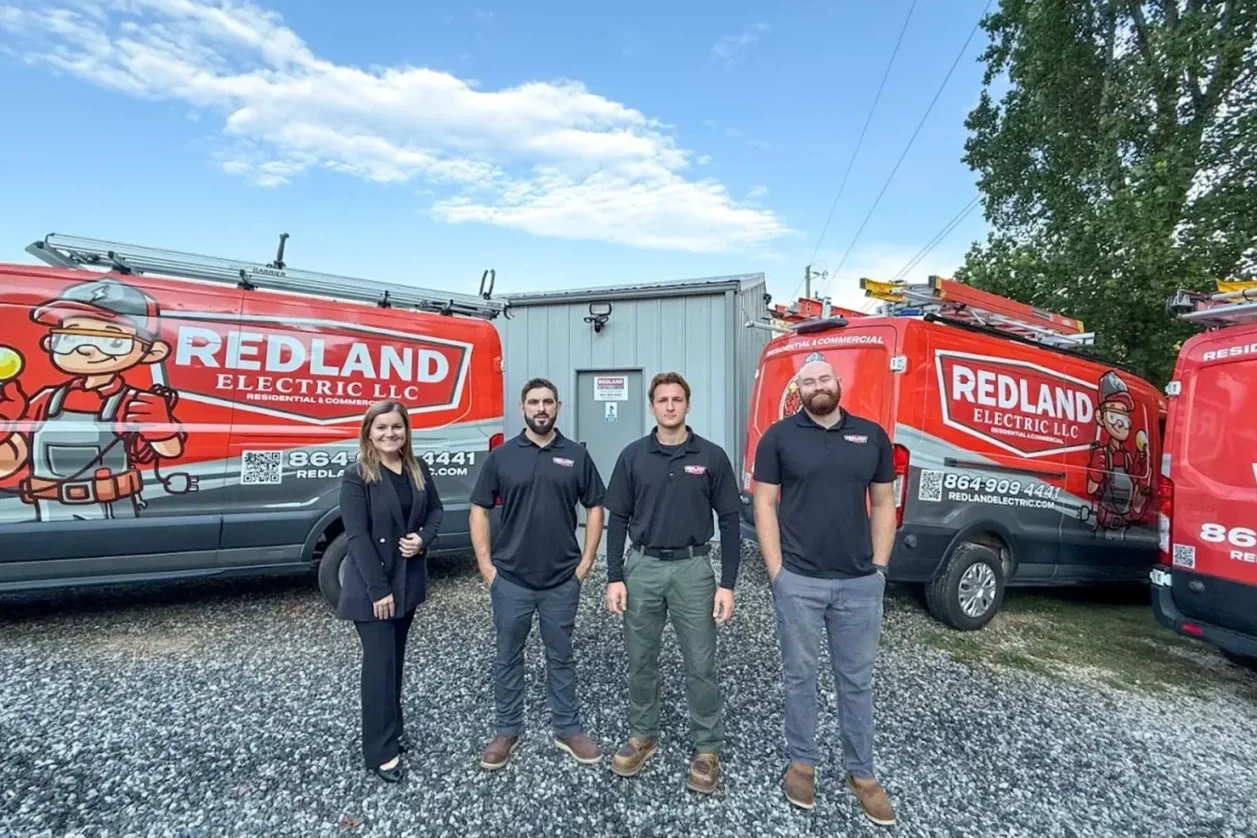
Redland Electric is a licensed electrical contractor serving Greenville and the entire Upstate South Carolina region. Our team provides complete electrical panel inspections, replacements, upgrades, and installations for residential and commercial properties. We serve Greenville, Spartanburg, Duncan, Five Forks, Simpsonville, Anderson, and surrounding communities throughout the Upstate.

Every electrician on our team is licensed, insured, bonded, and professionally trained for electrical panel replacement and installation. We are also locals, people who live in the Greenville community and are invested in keeping it safe. When you call a Greenville electrician from Redland Electric, you are not working with a national franchise or a call center. You are working with someone who understands this area, knows the housing stock, and is genuinely here to help.
Transparent Pricing — We provide clear, upfront pricing with no surprise fees and no charges added after the fact. Every estimate we provide reflects the actual cost of the job. We also customize our approach to each property, accounting for your current electrical system, your panel size needs, and your budget.
Full-Service Project Management — We handle the entire process from start to finish. That includes pulling the required permits, purchasing materials, completing the installation, scheduling and passing the county inspection, and cleaning up after the work is done. You do not need to manage any of that on your own.
Education and Support — After your new panel is installed, our electricians take the time to walk you through your new system, explain how it works, and share maintenance and safety tips so you feel fully confident operating it.
Serving Homeowners and Businesses Across the Upstate — If you have been searching for a licensed electrician near me, an electrical panel upgrade near me, or an electrical contractor near me in the Greenville area, Redland Electric is ready to help. Electrical panel installation in Greenville, panel replacement in Greenville, and electrical panel inspection in Greenville are services we perform regularly, and we bring the same level of care and professionalism to every job.
If your property has a Federal Pacific or Zinsco panel, do not put this off. The research is clear, the risk is real, and the solution is straightforward. Contact Redland Electric today to schedule your electrical panel inspection and take the first step toward a safer, properly powered home.